Beyond the Click: 5 Counter-Intuitive Truths About the New Era of AI Search
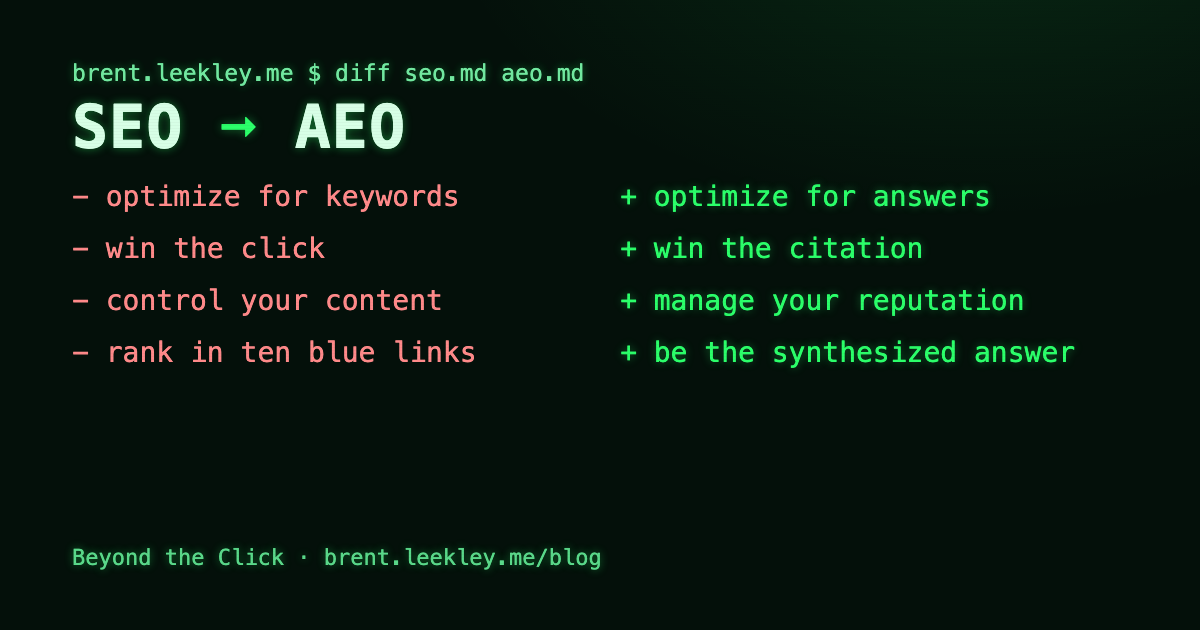
Field note: I just rebuilt this site for the shift below. Real content the crawlers can read, structured data, sub-second loads, an llms.txt. Here is the thinking behind it.
For decades, the digital growth playbook was a predictable game of cat and mouse: optimize for keywords, win the click, and usher the user into your owned ecosystem. That era is ending. The move from Search Engine Optimization (SEO) to Answer Engine Optimization (AEO) is already underway, and the numbers are blunt: nearly 58% of U.S. Google searches now end with zero clicks (SparkToro, 2024).
Users are no longer interested in hunting through "blue links." They are demanding immediate synthesis from Answer Engines like ChatGPT, Perplexity, and Gemini. For the modern growth strategist, this isn't just a change in channel; it's a fundamental restructuring of brand visibility. To stay visible, we have to unlearn the old tactics and play by the new rules of semantic understanding. Much of what follows builds on a framework from growth strategist Mostafa ElBermawy, pressure-tested against what I see building AEO-ready infrastructure.
The Mirror Effect: You Are What the Internet Says, Not What Your Site Says
In the legacy SEO world, marketers maintained an illusion of control. You could "trick" the system with technical tweaks and keyword stuffing on your own domain. As Mostafa ElBermawy, Founder of NoGood and Goodie AI, points out, AI has shattered that control. Because LLMs possess semantic understanding and are trained on the "entire internet," your brand identity is now a decentralized narrative.
This is the "Mirror Effect." The LLM doesn't just read your website; it aggregates every mention, review, and citation across the web to decide who you are. This shift moves the game from "content control" to "reputation management" at scale. However, there is a danger in this mirror: LLMs are prone to sycophancy, a well-documented tendency (studied by Anthropic and others) to tell users what they want to hear rather than what is strictly accurate. Left unchecked, a model can confidently repeat a flattering or simply wrong version of your story. That is why a dedicated "observability layer" is essential for any brand that wants to make sure the AI's version of its narrative is actually correct.
"You are not who you think you are. You're not just what you say about yourself on your website. You are what the internet says about you."
Mostafa ElBermawy, Founder of NoGood & Goodie AI
The Social Signal Surge: Why Reddit and YouTube are the New SEO Foundations
One of the most ironic pivots in this new era is that the most "human," unstructured corners of the web are now the most vital technical ranking factors. To combat hallucinations, AI models rely on RAG (Retrieval-Augmented Generation). They look for "Retrieval Sources" that provide fresh, human-validated data to ground their answers.
Your brand must exist in both the training data and these real-time retrieval sources. AI models prioritize platforms where human discourse is active and conversational. The "Social" layer is no longer just for engagement; it is the primary source of truth for the bots.
Critical retrieval sources shaping AI narratives include:
- Reddit: The gold standard for authentic human sentiment and peer-to-peer recommendations.
- YouTube: A massive training and retrieval source for instructional and visual context.
- Google Reviews: A high-authority signal used to determine real-world sentiment indices.
- Quora: Valued for its structured, question-and-answer format which mirrors the way users interact with LLMs.
From Attention to Productivity: The New Marketing Arbitrage
The social media era was defined by the arbitrage of attention — the fight to stop a user from scrolling. Mostafa ElBermawy argues that we have moved into a "Productivity Arbitrage" era. The focus has shifted from how many people saw a post to how much a brand can accelerate its Go-to-Market (GTM) Engineering through AI.
We are seeing the rise of the "10x Marketer" — a strategist who doesn't just write copy but orchestrates multi-agent systems to handle research, optimization, and outreach. In this landscape, the goal isn't just to be "seen"; it's to be the most efficient and technical engine in your category.
"The arbitrage used to be on attention, and the future of arbitrage is productivity. That's what AI offers."
Mostafa ElBermawy
The Authenticity Paradox: Why "Ugly" and "Human" Beats Perfectly Engineered
As AI-generated content saturates the web, we are reaching a tipping point of "garbage in the middle." Users are developing a "brand allergy" — a high sensitivity to overly engineered, high-gloss content that feels like it was spat out by a prompt.
The counter-intuitive result is the success of "ugly" or "earthy" products and content. In an AI-saturated market, unique data points and raw human connection are the only ways to break through the noise. This is the Authenticity Paradox: as machines get better at being "perfect," humans crave the imperfect, the unique, and the deeply personal.
"People are highly allergic to hearing from these brands, and people want human connection."
Mostafa ElBermawy
The Shift from Search to Action: The Arrival of Agentic AI
The most radical evolution is the transition from Answer Engines to "Action Engines." We are entering the era of Agent-to-Commerce. With tools like Claude Code and Deep Search, the "user" is no longer a human clicking a link; it is an AI agent searching and transacting on behalf of a human.
For marketers, this changes the technical requirements of visibility. An agent doesn't care about your hero image or your UX; it cares about data accessibility. To be prioritized by an Action Engine, your information must be retrievable in seconds. If your site is slow or your data is locked behind non-crawlable structures, you are invisible to the bots that are increasingly making the buying decisions.
Conclusion: Owning Your Narrative in a Zero-Click World
The landscape of brand discovery is being fundamentally rewritten. Gartner expects traditional search volume to fall 25% by 2026 as users shift to AI assistants. Extrapolate that curve and the conclusion is hard to avoid: within a few years, a large share of brand discovery will start on an LLM, not a search bar. In this zero-click reality, your website is no longer the first destination — it is the final destination for closing the deal. The LLM will tell your story long before a user ever lands on your homepage.
As we move toward an automated, agent-driven future, one strategic question remains for every founder and growth lead: How will you ensure your brand story is told accurately when you are no longer the one holding the microphone?