Why 40 MHz Is the Right Default Channel Width in 6 GHz
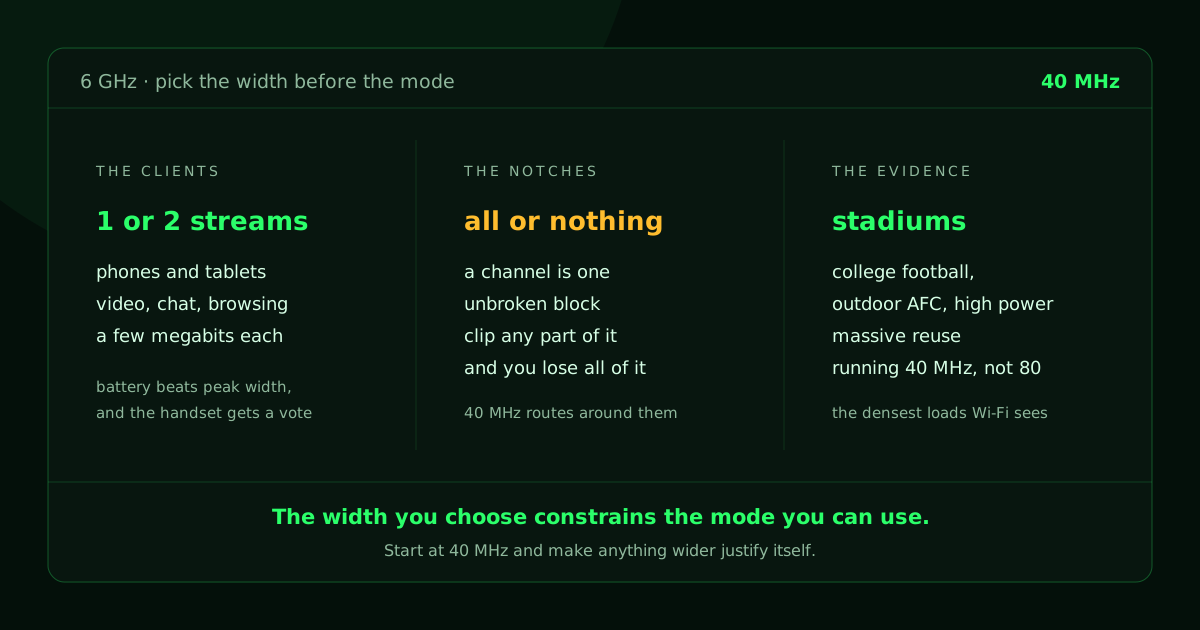
Third post in the 6 GHz power mode series. Posts one and two covered the LPI versus Standard Power decision and the AFC machinery behind Standard Power. This one covers channel width, which is the spectrum column of the power, spectrum, and operations trade. The mode decision and the width decision are really the same conversation, and in 6 GHz the width goes first, because the width you choose constrains the mode you can use.
What are your clients actually doing?
Your clients are doing less than the spec sheet assumes, and that is the whole argument in one line.
Spec sheets and launch decks talk about 160 and 320 MHz channels, and the math on those slides adds every radio together into one headline number. The clients paying the bill for your design do not look like that. The devices arriving on enterprise 6 GHz networks are mobile-first: phones and tablets with one or two spatial streams, running video streaming, messaging, and browser traffic that needs a few megabits per second. A 40 MHz channel with a good MCS rate covers that with room to spare.
Battery is part of it too. Sustaining an ultra-wide channel costs a mobile radio power and heat, and handset radios are built to prioritize battery life over peak channel width. So even when you hand a phone a 160 MHz channel, the phone gets a vote on how hard it works, and it usually votes for its own battery. Wide channels mostly benefit the small population of wired-adjacent laptops moving big files, and that is not the population filling an auditorium.
Buying width you cannot spend is the same mistake as buying a three-quarter-ton truck for a ten-mile commute. It is not that the truck is bad. It is that you paid for a capability you will never put to work, and in a channel plan you pay for it in reuse.
Why do clients already prefer 6 GHz?
Because the operating systems decided for you, and that turns out to do a lot of design work on your behalf.
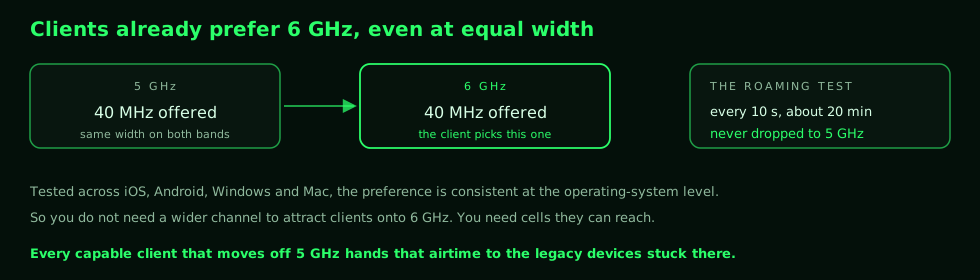
The panelists on the Tech Field Day podcast that prompted this series have tested client band selection across iOS, Android, Windows, and Mac, and they report a consistent operating-system-level preference for 6 GHz over 5 GHz, even when both bands offer the same channel width. Keith Parsons described a roaming test across a large site, sampling every ten seconds for around twenty minutes, in which a 6 GHz-capable client never once dropped back to 5 GHz.
That preference pays you twice. Every capable client that moves to 6 GHz stops consuming 5 GHz airtime, and the legacy devices stuck on 5 GHz get a faster network without you touching anything on their band. It is the rare change that improves a band you did not work on. And because the preference holds at equal width, you do not need ultra-wide channels to collect it. What you need is 6 GHz cells the clients can actually reach, which loops straight back to the talk-back and power mode discussion from post one.
How channel width interacts with each power mode
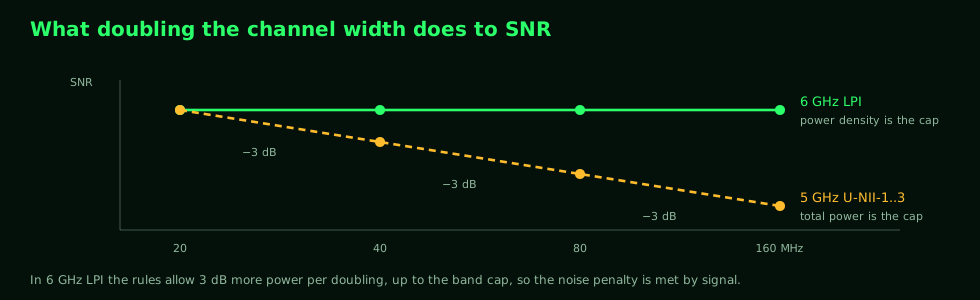
In LPI, the power spectral density rule adds 3 dB of allowed transmit power each time width doubles, up to the band's EIRP cap, so an AP that spends the allowance can hold its SNR and wide channels genuinely work. If your design goal is maximum per-client throughput, LPI with wide channels (80, 160, or Wi-Fi 7's 320 MHz) is the highest-throughput configuration Wi-Fi currently offers, and I would not talk anyone out of it when that is the actual goal.
Standard Power is where width gets expensive. The AFC exclusion masks from post two can remove chunks of the band, and a notch anywhere inside a wide channel's block removes the entire channel, because a channel has to be one unbroken run of spectrum.
Think about parking. A lot with a few pillars scattered through it still parks plenty of cars, because a car can go almost anywhere the pillars are not. Put one of those same pillars in the middle of a bus bay and the bus does not fit at all, and the pillar did not get any bigger. That is a notch against a 40 MHz plan versus a 160 MHz plan. The obstruction is the same size in both cases, and the bill is completely different.
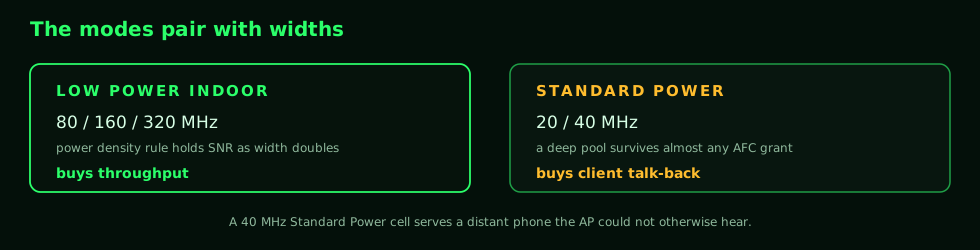
How much you lose depends on the incumbents around your site. A clean grant can support 160 MHz, and Cisco documents 160 MHz Standard Power operation, so this is not a prohibition. But a wide-channel Standard Power plan is a bet on the incumbent map at every site you deploy, and a notch you did not plan for takes out a channel you could not afford to lose. Standard Power at 20 or 40 MHz keeps a deep channel pool and healthy reuse under almost any grant, which means the design survives a grant you did not get to preview.
So the modes pair naturally with widths. LPI pairs with wide channels and buys throughput. Standard Power pairs with 40 MHz and buys client talk-back. If you have a phone at the edge of a large room, a 40 MHz Standard Power cell will serve it better than an 80 MHz LPI cell, because the wider cell does the phone no good if the AP cannot hear the phone answer.
The evidence from high-density deployments
Outdoor stadium deployments have been running AFC longer than indoor ones, so they are the closest thing we have to operational history, and the panel pointed to college football stadiums as the working example. Those networks run 40 MHz channels under AFC, at high power, with massive reuse, and they hold up under the densest client loads Wi-Fi sees.
That is worth more than a datasheet argument. These are teams that would happily run 160 MHz if 160 MHz worked better for them, operating under real AFC grants with real crowds on the network, and they chose the narrow channel and more of them.
There is also a portability argument that shows up on the invoice eventually. The US got the full 1,200 MHz; much of the world did not, and 80 MHz plans get difficult in regions with less spectrum. A 40 MHz design built in the US carries to most international sites with far less rework, which is worth real money to anyone running a global standard.
Where do I come down?
Start at 40 MHz for enterprise 6 GHz, in either mode, and make anything wider justify itself.
Go wider only when you can point to the client population and the application traffic that needs it, and your mode supports it. LPI keeps wide-channel SNR by rule, so it is the mode that can honestly carry an 80 or 160 MHz design. Standard Power needs a clean grant at every site, which is a condition you do not control and cannot confirm in advance.
If you are going to Standard Power for talk-back reasons, plan 20s and 40s from the start and let the AFC masks fall where they fall. A plan built to survive the notches does not care much where they land. The last post in this series covers how to see all of this on a Catalyst 9800 over NETCONF, and how to monitor the AFC pieces so the database never surprises you.
The rest of the series
- Choosing a 6 GHz Power Mode: Low Power Indoor or Standard Power.
- What AFC Requires From a Standard Power Access Point.
- Why 40 MHz Is the Right Default Channel Width in 6 GHz (this post).
- Configuring and Monitoring 6 GHz Standard Power on a Catalyst 9800, Programmatically.